
More Frequently Asked Questions in Museum Documentation
I've got a huge number of undocumented objects and I haven't got a clue where to start
Get a copy of the mda factsheet Retrospective Documentation. A copy of "Facts and Artefacts" by Stuart Holm will also help to build a reliable foundation.
Old Haa (community museum), Yell, Shetland
Is there a standard list of terms used in museums?
No! A lot of work has been done on terminology for museum use, but attention has moved away from producing standard term lists and towards the idea of using thesauri. The biggest, and best, thesaurus is the Art and Architecture Thesaurus, produced by the Getty Research Institute. It is the result of international collaboration over many years and can be searched on-line. The mda's Word Hoard web pages contain a list of other sources. Other long-term projects in the terminology field include the Social History and Industrial Classification, ICOM classification for costume and the Iconclass scheme for describing the iconography of art works. These are widely used by museums all over the world.
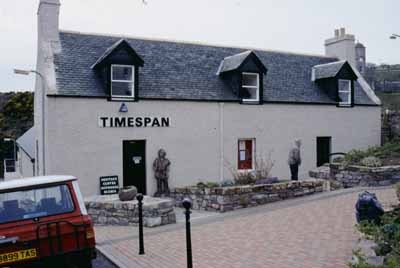
Timespan, Helmsdale
My employers want me to provide public access to information about the collections. How can I do this?
It should be obvious that, unless you have the information in a digitised form you cannot supply it to your public by means of a computer. So the top priority should be to compile a record of everything that you have. Once that is done, most modern database systems can be set up to provide simple interfaces for public access, either at stand-alone terminals (often known as kiosks) or across the Internet.
The question of providing images as well as the bare text records will arise sooner or later. The cost of acquiring digitised images of your collections can be very high, and you might not think it worthwhile to provide an image of every object. A digital camera could be used for fairly crude and small images of objects, but the types of camera affordable by the average museum do not produce images of high enough quality for submission to national projects, such as the Scottish Cultural Resources Access Network, for example.
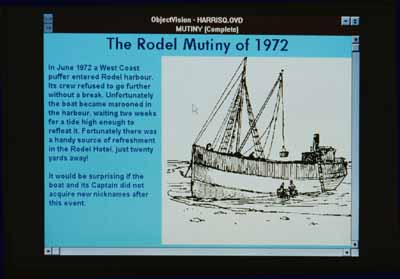
The Western Isles National Database Evaluation Exercise (WINDEE) - a precursor of SCRAN
If you have some photographs of objects in your collection, these can be scanned fairly readily, but this is a time-consuming process. Many museums, for example, are digitising their collections of local history photographs, but often find that the mixture of original formats and sizes mean that it is difficult to automate the process.
Everyone seems to be talking about the "Dublin Core", "Z39.50" and the "CIMI Schema" these days. What on earth do they mean?
They are all ways of helping people to find the information they are looking for, and to exchange information. Dublin Core is a system of tags for use with the Hyper-Text Mark-up Language (HTML), used to provide formatted information across the Internet. The document you are reading, for example, incorporates tags which tell your browser software when to put something in italics or underline it. The Dublin Core tags will indicate what sort of information is included within them, for example that the enclosed text represents the catalogue record of a book, or a museum object, and all the details of the said object, or its "surrogate". Just as tools have been developed to make HTML coding simple and invisible, so it is hoped that tools will become available so that you can search the Internet for all museum objects associated with the author Charles Dickens, for example. The original Dublin Core was developed, by consensus, at a workshop in Dublin, Ohio, by a group of people representing various domains within the information world - libraries, museums, archives, etc. Often described as a standard for metadata (i.e. data about data), its various schemes, qualifiers and extensions can accommodate pure data, such as individual museum object records, as well. Z39.50, on the other hand, is a protocol for the exchange of information between database systems. Most users do not need know or understand anything about it, as it will be incorporated in the leading products in the field. It is, however, a useful term to throw into conversations where you want to impress a listener.
The CIMI schema is a standard means of tagging museum records for use with the XML (eXtensible Markup Language) language. Software which supports this file format should have no difficulty importing and exporting records from and to other compliant systems, thus making data conversion tasks much simpler. It will also enable intelligent cross-searching of museum databases.
Frequently Asked Questions - Part 1